Hi, I am Lea Thome.
I am an international security researcher focused on China, originally hailing from Germany. My research focuses on understudied economic, technological, military, and political chokepoints that can influence global peace and security. In the past, I have researched and written about ports, shipbuilding, security equipment, AI deployment, datacenters, critical minerals, space, and renewable energy.
I gained my bachelor’s degree from the University of Rochester and my master’s degree as a Schwarzman Scholar from Tsinghua University.
Research & analysis
Over the past two years, I have authored almost 50+ reports, articles, and analysis for various think tanks, organizations, media outlets, and for personal learning and reflection. I primarily enjoy working with primary-source materials from official government sources.
Some of my recent work includes:
PRC Deploys DeepSeek Across Local Governments (China Brief, 2025)
“Beijing has moved to codify its development and deployment of artificial intelligence (AI) in domestic and international settings, including at the Two Sessions and the United Nations. At least 72 local governments across the People’s Republic of China have already deployed homegrown AI model DeepSeek, according to a domestic think tank. Officials expect AI deployment in government to expand rapidly with the development of new models, even though such technologies have remained limited to customer and business services in the short term.A lack of compute infrastructure and energy resources in many parts of the country constitute a bottleneck for rapid adoption of AI products to power government services.”
China’s global scanner dissemination (AidData, 2025)
“In July 2023, AidData’s Harboring Global Ambitions report examined the linkage between China’s development financing of port projects and potential future naval bases. This analysis follows up on that research, to explore where else Chinese development finance may have national security implications for recipient countries.
Since 2000, Chinese state-owned entities have provided 210 grants and loans for the acquisition and installation of scanner equipment in 91 low- and middle-income countries. China’s distribution of scanners has enabled recipient countries to minimize security risks (such as detecting contraband and explosives) and increase revenue for local customs authorities. Despite these benefits, scanning equipment provided by Chinese enterprises with governmental oversight could give Chinese authorities insight into sensitive data, from biomedical information to military transshipments.”
A New Agenda for Trilateral Cooperation: Strengthening US-Japan-ROK Shipbuilding Capacity (Pacific Forum, 2025)
“Lea Thome’s article, A New Agenda for Trilateral Cooperation: Strengthening US-Japan-ROK Shipbuilding Capacity, opens the section with a timely analysis of trilateral cooperation between the United States, Japan, and South Korea in the shipbuilding sector. Noting that China dominates global shipbuilding capacity with 53 percent of global output, while South Korea and Japan rank second and third, respectively, Thome argues that reviving US shipbuilding capabilities is essential. Achieving this will require both industrial policy at home and regional partnerships abroad. This article highlights opportunities for initiating a trilateral strategic dialogue on shipbuilding and ship maintenance. This includes potential cooperation in areas such as co-investment in shipbuilding industries (including shipyards, ammonia-fueled ships, and icebreakers) and adjacent industries like steel; technology exchange and workforce development; and the formalization of routine ship maintenance at allied shipyards.”
Some of my forthcoming work includes:
Ports of Power (2026): a report on China’s dual-use overseas ports network, initially authored for the Wilson Center.
An article on China’s alternative lithium supply chains: sodium and salt lakes.
A book chapter (2026) on the U.S.-China-EU relationship.
A report on China’s space ambitions and activities.
Some further short-form analysis on economic and military chokepoints…
Data visualizations & geospatial imagery
I like to combine quantitative analysis of large-scale datasets with qualitative case studies and geospatial imagery. In particular, I have specialized in open-source imagery using platforms and applications like Google Earth, Datawrapper, ArcGIS, Photoshop, Flourish, and Planet Labs.
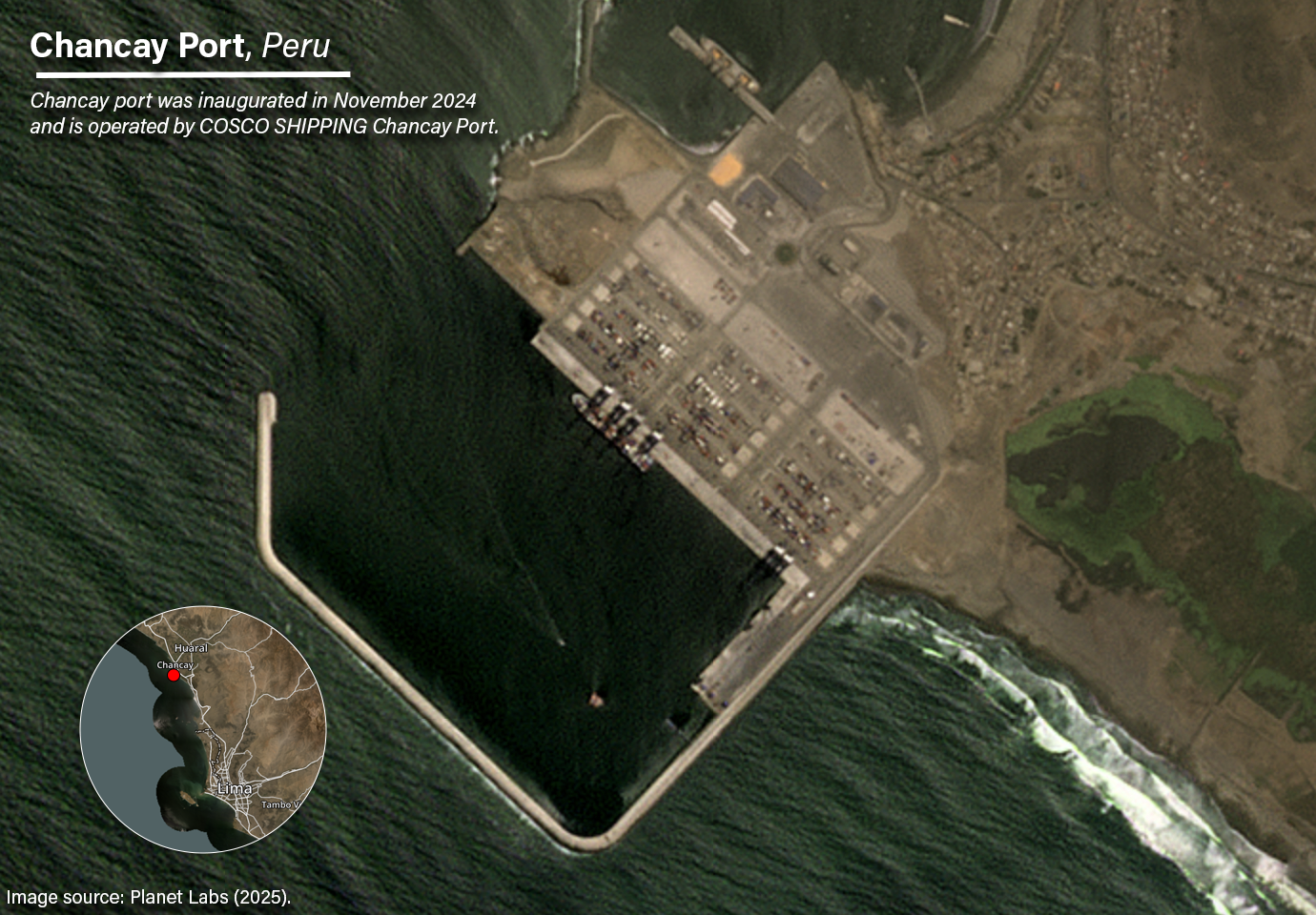
Ports of Power (2026), forthcoming:
As part of a forthcoming report on China’s global maritime statecraft, I created three geospatial visualizations for the case studies featured in the report. For this image, I looked at the Port of Chancay in Peru, using Planet Labs.
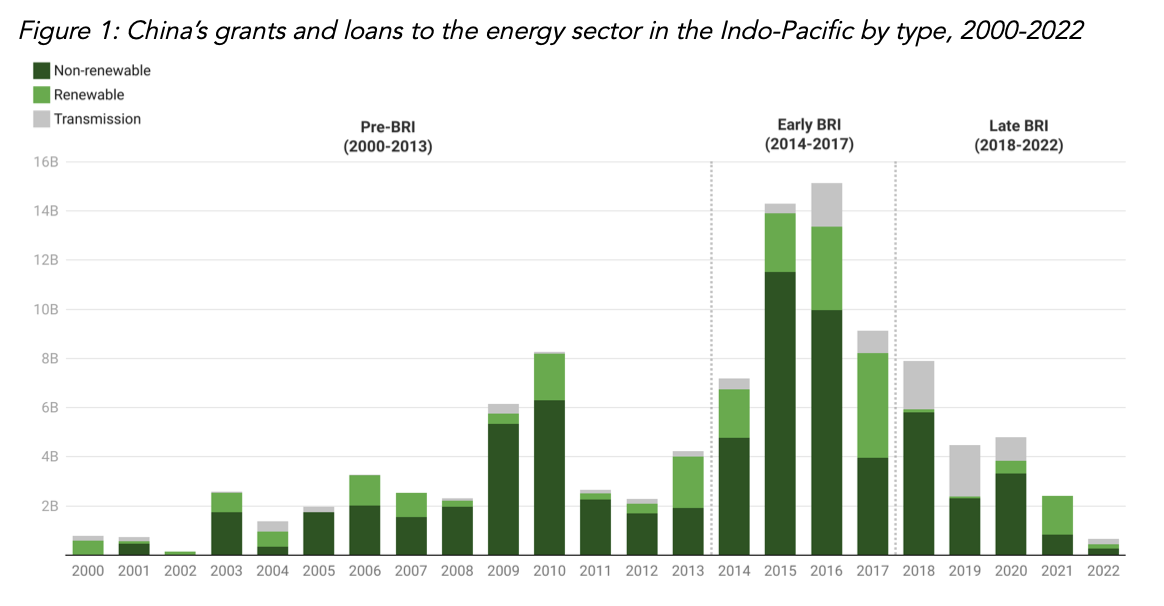
Greening the Indo-Pacific (2025), AidData:
In addition to lead-authoring this piece, I also formatted and visually-designed this report, creating all data visualizations in the openly-accessible Datawrapper. You can find this graph on Page 3 of the report.
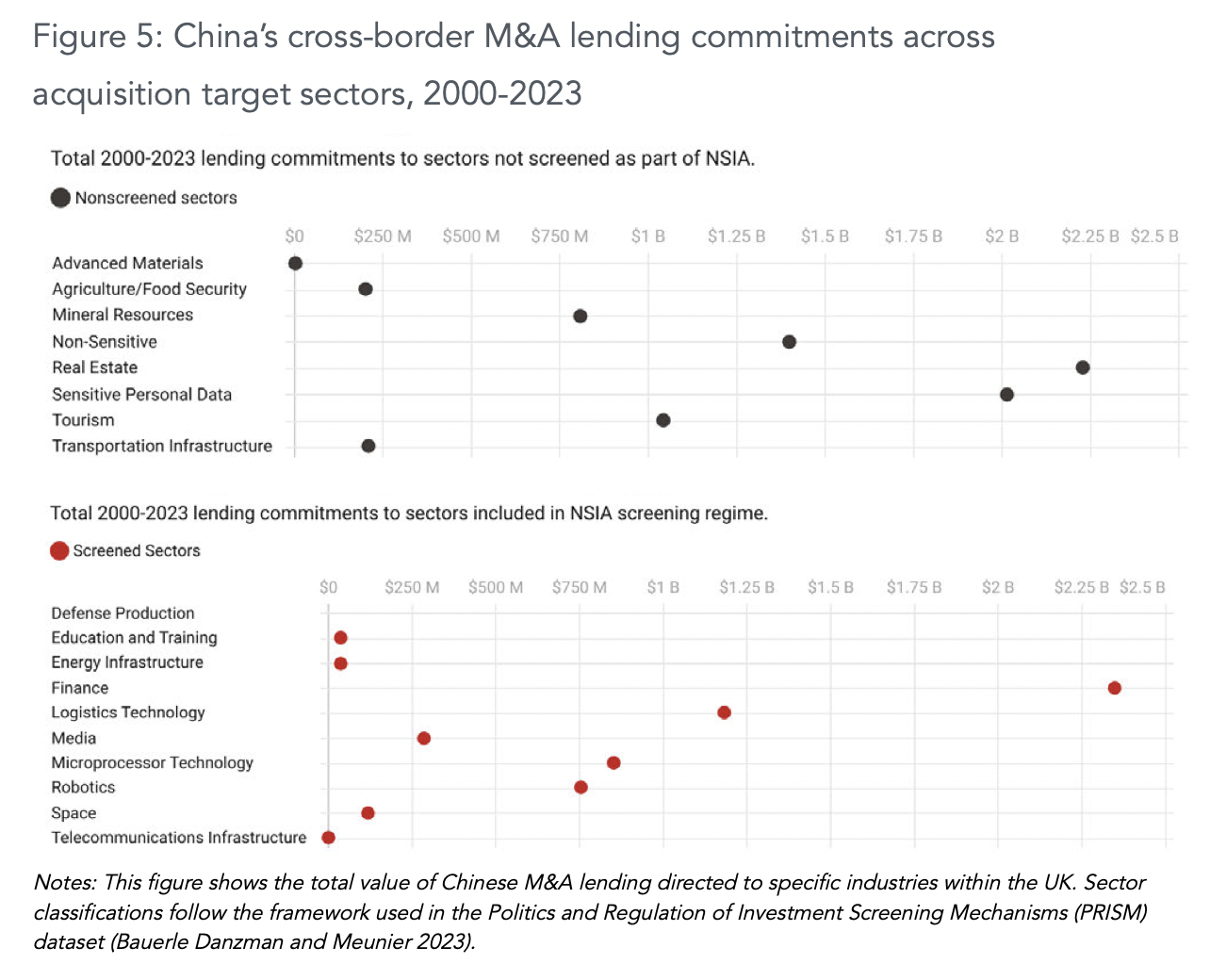
Beijing’s UK Lending Operations (2025), AidData:
As a co-author on this report, I used AidData’s Global Loans and Grants Dataset, Version 1.0, and assessed where Chinese official sector financing is flowing to in screened sectors in the UK, using the PRISM dataset (2023). You can find the analysis here.
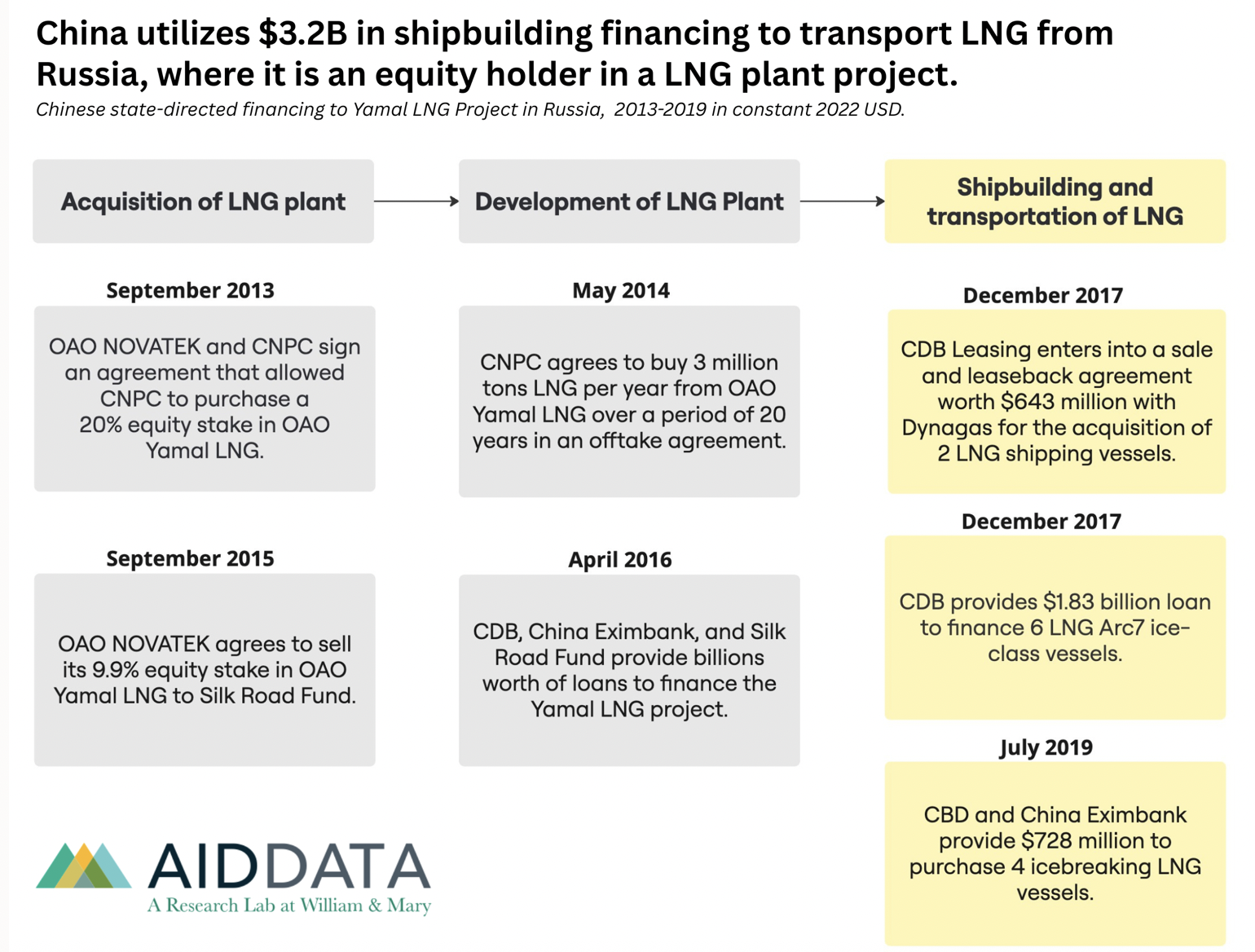
How China is Financing Its Domestic Shipbuilding Industry (2025), AidData:
I single-authored this blogpost for AidData’s website, creating my own dataset and manually coding new variables. Some projects, however, were too complex for a simple graph or in-text explanation. I created this flowchart to explain linked financial transactions, which you can find in the blogpost here.